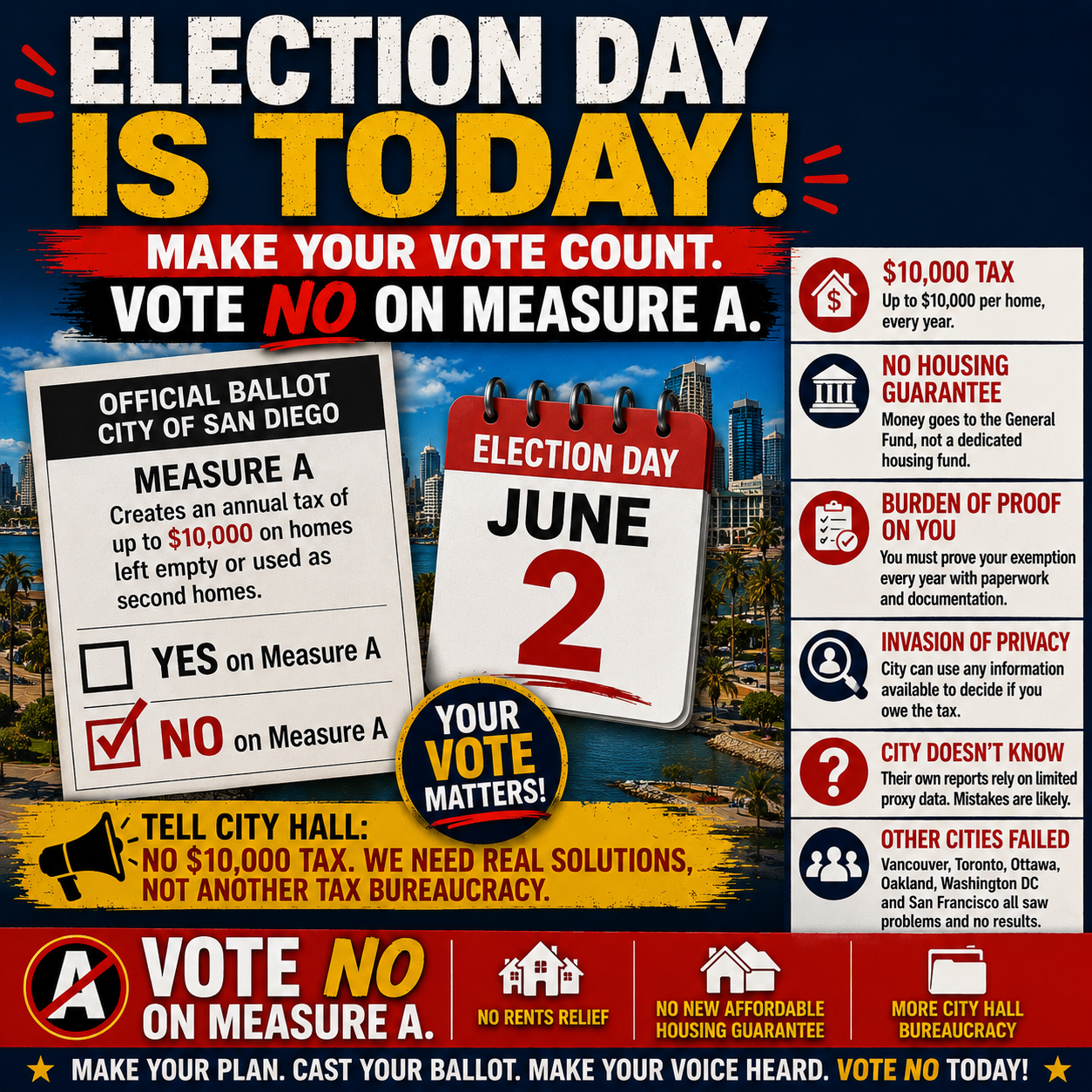
How Would City Hall Track Whether You Stayed in Your Own Home?
Measure A is built around one very personal question:
How often was your home occupied?
That may sound simple.
But in real life, it raises a much bigger question:
How exactly is City Hall going to track whether people stayed in their own homes?
Measure A does not give voters a clear answer.
And that is the problem.
Measure A Turns Occupancy Into a City Investigation
Under Measure A, a home can be taxed if the City decides it was vacant for more than 182 days in a calendar year and does not qualify for an exemption or exclusion.
That means City Hall has to figure out who stayed where, for how long, and under what circumstances.
Was the home occupied?
Was it leased?
Was the lease good enough?
Did a family member live there?
Did the owner qualify for a medical, military, disaster, death, or other exclusion?
Was the paperwork submitted correctly?
Was the proof good enough?
If the City does not like the answers, the property owner could face a $10,000 tax.
The City Can Audit You
Measure A gives the City audit powers over all of this.
That means if the City questions whether a home was properly exempt or excluded, the owner may be forced to produce records and defend their claim.
And this is not just a short-term issue.
The measure allows audits years up to 10 years later, meaning property owners may have to keep records long after the calendar year in question.
So ask yourself:
Could you prove, years later, exactly how your home was used?
Could you prove which family member stayed there?
Could you prove how many days they stayed?
Could you prove a lease was valid?
Could you prove an extended absence qualified?
Could you produce the paperwork City Hall decides it wants?
That is what Measure A could require.
You really need to think about that. If a City bureaucrat asked you, today, to prove how many days you lived in your own home in 2017 (9 years ago, within the audit window), could you? Not just know it, but PROVE IT?
What Records Will City Hall Demand?
Measure A does not fully spell out what documents the City will require.
That comes later.
But other cities with vacancy taxes show where this can go.
In cities that have tried similar policies, residents and landlords have been asked for documents such as utility bills, driver’s licenses, insurance records, cell phone bills, lease agreements, tenant records, bank records, tax documents, and other proof of occupancy.
In Ottawa, one homeowner who obviously lived in his home was reportedly asked to provide evidence such as seven months of utility bills, vehicle registration or insurance documentation, government-issued ID, or government correspondence.
In Vancouver, renters were pulled into the process when landlords had to gather tenant documents to prove units were occupied.
Vancouver enforcement agents said they would use secret data mining techniques to decide who occupied their own homes.
That is the reality of an occupancy tax.
It does not just ask whether a home is empty.
It creates a system for government to prove — or force you to prove — how people live.
This Is a Privacy Problem
San Diegans should not have to hand over personal records to City Hall to prove they stayed in their own homes.
They should not have to document family arrangements.
They should not have to prove how often relatives stayed.
They should not have to worry that tenant records will be dragged into a tax audit.
They should not have to save years of personal documents in case City Hall questions them later.
A home is not just a taxable unit.
It is where people live, raise families, care for loved ones, recover from hardship, and make private decisions.
Measure A turns those private decisions into a City enforcement matter.
The Rules Are Still Not Clear
Supporters want voters to believe Measure A is narrow and simple.
But the measure gives City Hall broad authority to write rules, regulations, interpretations, and guidelines later.
That means voters are being asked to approve the tax before knowing how the City will actually enforce it.
Will the City use utility data?
Will it demand leases?
Will it ask for tenant records?
Will it ask for proof of family occupancy?
Will it require medical, military, or travel records?
Will it use complaints from neighbors?
Will it use other records or technology?
Measure A does not give voters clear limits today.
It says: trust City Hall.
San Diegans should not.
Other Cities Are a Warning
Vacancy taxes have created real problems elsewhere.
Residents who lived in their homes have been wrongly billed.
Seniors have been confused by paperwork.
Tenants have been asked to provide private documents.
Homeowners have had to fight bureaucratic mistakes.
And local governments have struggled to administer these systems fairly and accurately.
That should be a warning for San Diego.
If City Hall cannot even clearly tell voters how this system will work before the election, voters should not hand them the power to create it after the election.
Don’t Let City Hall Track Your Home
Measure A is not just a $10,000 tax.
It is a new system for City Hall to monitor, question, audit, and second-guess how homes are used.
That is invasive.
That is risky.
And it is not a real housing solution.
San Diego needs more housing, not more surveillance, more paperwork, and more bureaucracy.
Protect your privacy.
Vote No on Measure A.